judylarsen

Mathematics educator and consultant. Exploring the possible and engaging minds.

Menu

Skip to content
  • About me
  • Publications
  • Presentations & Workshops
  • Resources
  • Blog Archive
  • Contact Me

Monthly Archives: April 2016

Supporting Student Innovation

Posted on April 13, 2016 by judylarsen

You know the classic question:

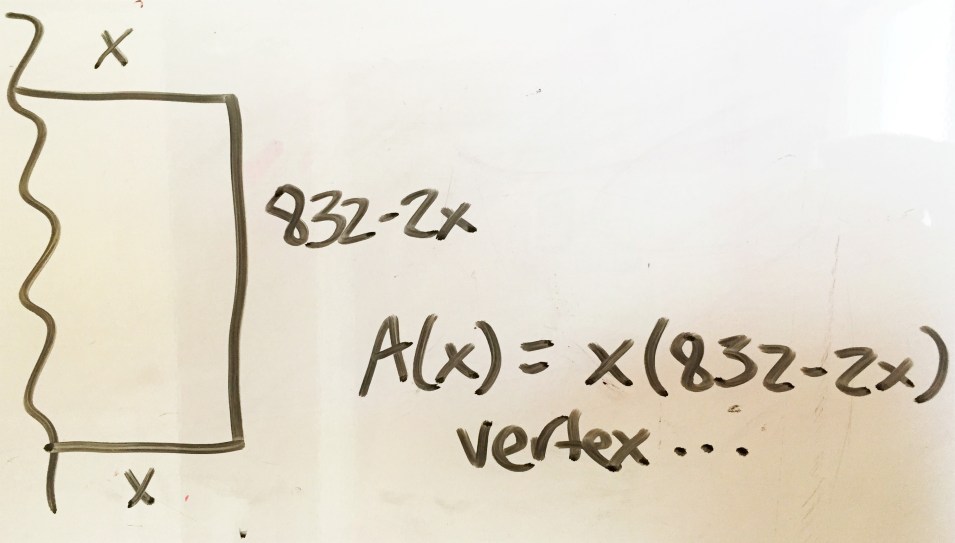
You have 832 ft of fencing and you want to build a rectangular pen along side a river with maximum area. 

Well, as we know, the textbook approach to this is generally to create a length and width equation, use it to create an area function, and find the maximum value of this function.
20160413_180533527_iOS

Depending on how you go about it, it gets a bit thick on the calculations, and most students require a calculator for it. They can learn the procedure though and it works for them.

HOWEVER,  I had a student come up to me after a class where I asked them to find the dimensions of a patio we could build with a given number of feet of fencing outside our classroom so that we have the maximum area possible. He told me that he thinks he has noticed a pattern within these problems where there is a 2:1 ratio between the sides for a maximum area.

My gut instinct was to introduce doubt, but encourage him to continue pursuing this idea. I told him about how mathematicians will notice things they think may always be true, and then find ways to prove or disprove their conjectures. I also told him that one way to easily disprove it is by finding a counterexample. So I set him on his way telling him to try many examples and see if his idea ever fails.

He had shared a few attempts at explaining his rationale with me, but they were not convincing. I wasn’t sure if he’d pursue it further or not, but I left it at that.

About two weeks later, which was last night, this question was on a quiz. This student, along with another student, were chatting after class . . . because they just can’t get enough of math class . . . and were discussing the farmer’s-pen-by-the-river problem. They are both very engaged and creative students who are both very strong thinkers. But the contrast in approaches was interesting to observe.

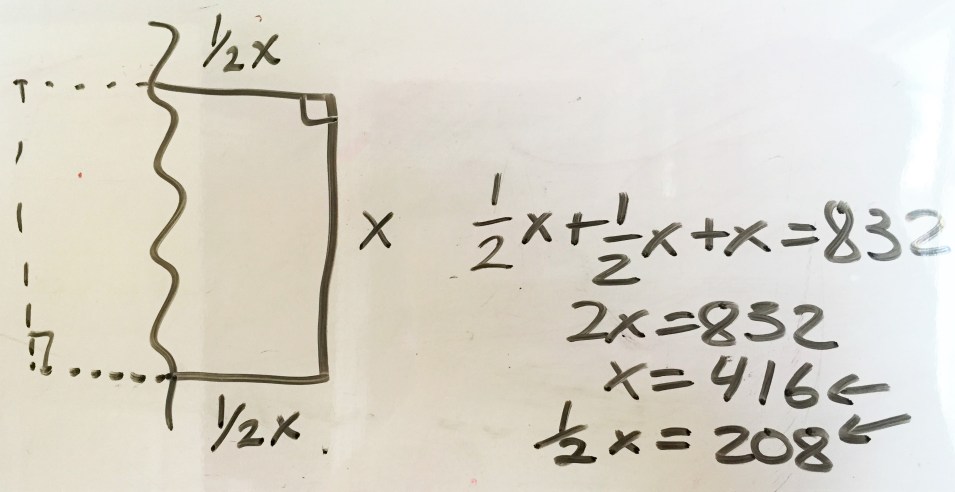
One student asked the other about how they approached this problem, and the student who had spent all this time thinking about his conjecture didn’t remember what he got on the problem. So the other student reminded him of what the problem was, and went on to explain the classic solution approach of using the vertex of the area function to find the maximum value for the length of the pen. The other student smiled, and said, “why do all that work when you can do this . . .” and he showed the following:
20160413_180735362_iOS

The part that blew me away was his reasoning:

HE EXTENDED THE RECTANGLE INTO A SQUARE!

Way to think out of the “box” . . . pun intended – lol.

By claiming that the area is maximized when something is a square, and that the pen problem is really always half a square, the proportions can be used to quickly deduce the length and width.

And even at this point, I continued my doubt. I told him that this is a very elegant and creative idea, and it clearly gives the right answer in this case, but that he should further work on how to convince someone that this is always the case.

What impressed me the most is that the doubt that I provided early on somehow motivated the student to refine his thinking.

I know for sure that without all of the work on building a classroom culture of thinking and communicating, this would not have happened in this way. Without random groups, these students would not be working together, commuting to class together, pursuing the next math class together, and discussing Greek Philosophy together after class (true story, they actually were)!

Opening up communication and visibility of thinking in class is so important. I am finding this idea being supported within the work of my colleagues. The other day, one of my colleagues told me she notices a big difference in student thinking when she has a classroom where students can work on whiteboards around the room. Another colleague also recently shared with me that she notices a huge difference in student participation with each other in a lecture based university level math course when she takes the time to implement a social activity during the first class. We really need more SOCIAL in the university learning context.
Posted in Classroom Engagement / Leave a comment

Systems of Linear Equations – Thanks #mtbos!

Posted on April 13, 2016 by judylarsen

I just LOVE the MTBoS Search Engine! I want to send out a public thank-you to all who contributed to making this happen.

I was planning my lesson on systems of linear equations, and within an hour, I had a nice progression . . .

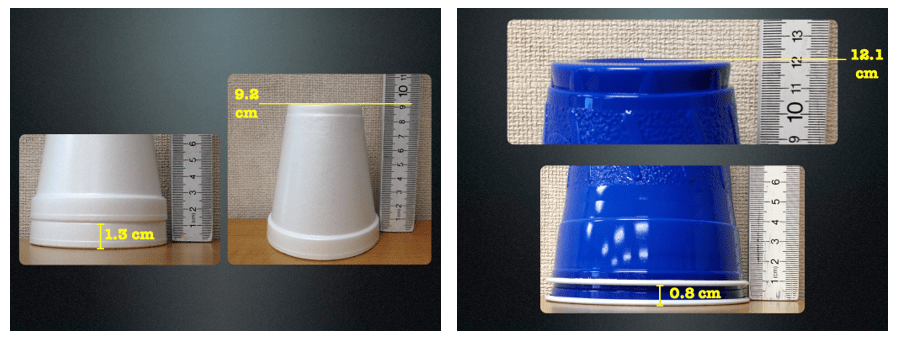
I started with Andrew Stadel‘s stacking cups Act 1 video. I proceeded a la Dan Meyer by asking – what questions do you have? This resulted in all sorts of answers, but soon, students began asking about the measurements . . . I decided to feed the hungry and tell them these cups were pre-measured for them!

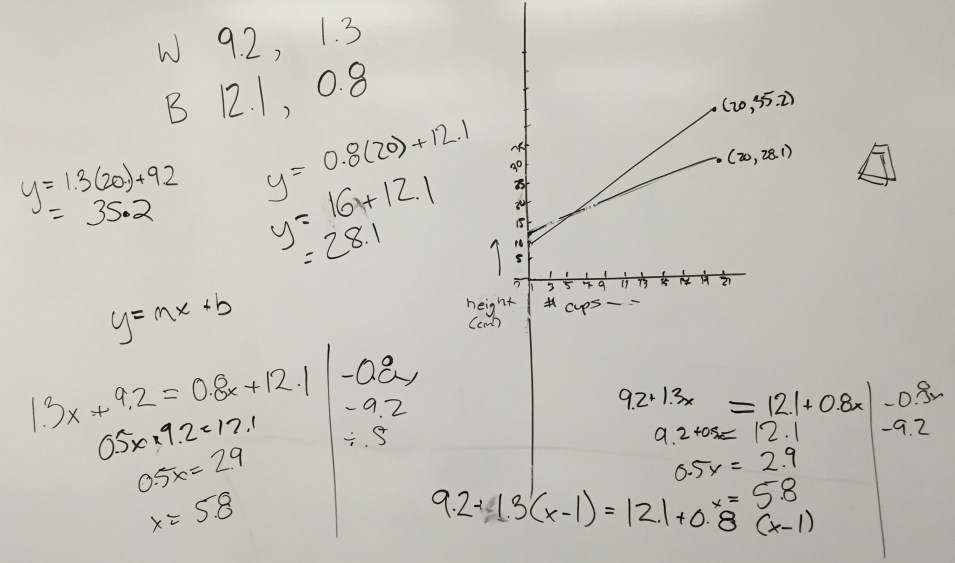
cup measurements.PNGThis was great! I got them into their #vnps formation with a deck of cards, and off they went at their collective question of – how many cups until they are the same height?
Some groups expressed some frustration with understanding the problem so I brought in some stacked cups and suggested they try to find their heights. This helped.

Over the next 20 minutes, interesting discussions were generated within the groups:

  • One was around rate of change as the steady increment of cup height.
  • The other was around defining variables.

My favorite question was when a student asked:

“Why is it that at 0 we have a height? Shouldn’t 0 cups have no height?”

20160203_024039165_iOS (2).jpg

My response was:

“What does your x mean?”

Somehow, this question brought light into the situation, and the group revised their equation.

Being inspired by this group’s realization, I began asking other groups about what their variables mean. Some explained their x refers to the number of cups in the stack, while others explained their x refers to the number of cups in the stack after the first cup.

I chose to bring attention to this to the class as a whole. Once they sat down, I asked them what the equation should be. I had mixed answers. Then I asked what x means for each. As a whole class, we noted that y = 1.3 x + 9.2 is an equation for height y of x cups after the first cup, and y = 1.3 (x-1) + 9.2 is an equation for height y of x cups total. We also noticed that 1.3 was the rate of change in both cases, and it was the slope of the graph of that line.

Because of this discrepancy, the class as a whole has now established that defining variables is VERY IMPORTANT! This has become part of the classroom culture and discourse.

If I had told them to begin with, “you must define your variables,” it would have not made it into their practice – BUT, since it really mattered in this problem, it stuck! More importantly, a general focus on meaning was introduced.


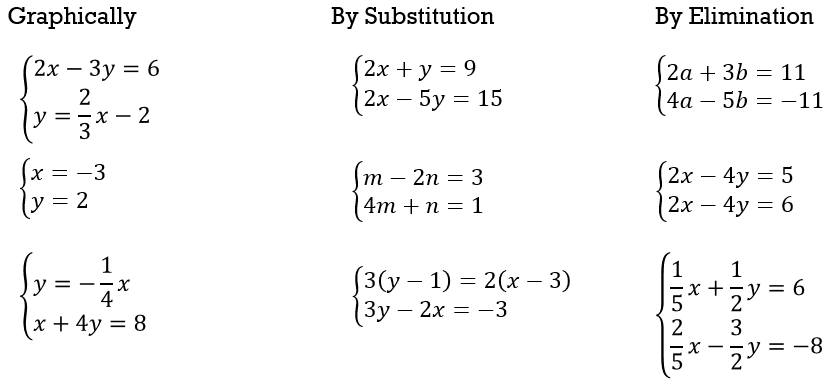
This was followed by a general discussion about systems of equations, possible results to a system of equations, and approaches to solving.

systems of equation options

Although this is the dry part, I find that the time we took to systematically have them work through solving the following systems was time well spent because it brought them into their comfort zone of algebra:

systems.PNG

After this formality, I sensed the desire for more problems! Time to get them back out of their comfort zone and into ambiguity again!

The scenarios we explored included the following #MTBoS inspired ideas:

Double Stuff! (from Christopher Danielson’s “My Oreo Manifesto“)

double stuff.PNG

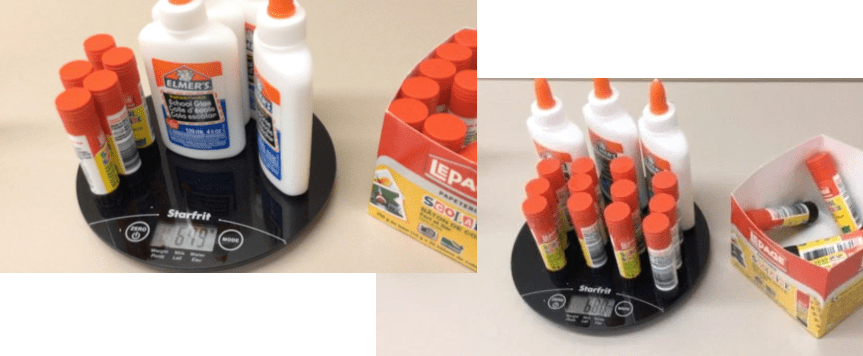
Glue Sticks! (from Kyle Pearce’s “Piling Up Systems of Linear Equations“)

glue.PNG

If we had more time, I would ask them to create their own scenarios.

Posted in Activities, Classroom Engagement / Tagged MTBoS / Leave a comment

Archives

  • September 2018
  • November 2017
  • June 2017
  • April 2016
  • February 2016
  • January 2016
  • July 2015
  • January 2015
  • December 2014
  • June 2014
  • February 2014
  • January 2014
  • September 2013
  • August 2013
  • July 2013
  • June 2013
  • March 2013

Meta

  • Create account
  • Log in
Blog at WordPress.com.
  • Subscribe Subscribed
    • judylarsen
    • Already have a WordPress.com account? Log in now.
    • judylarsen
    • Subscribe Subscribed
    • Sign up
    • Log in
    • Report this content
    • View site in Reader
    • Manage subscriptions
    • Collapse this bar
 

Loading Comments...